Dyes vs Pigments in Textiles: Types, Fibre Compatibility and Environmental Impact
Colour in textiles looks simple on the fabric, but it is one of the most chemistry-heavy parts of the whole supply chain. A cotton T-shirt, a polyester sports jersey, a wool shawl and a printed bedsheet cannot all be coloured well with the same material. The fibre decides the colourant, the process, the auxiliaries, the washing load and, in many cases, the pollution risk.
The two main colourants used in textiles are dyes and pigments. They both give colour, but they behave very differently. A dye usually dissolves in the dye bath and forms an attraction with the fibre. A pigment does not dissolve and normally needs a binder to stick to the fabric surface.
That difference affects shade brightness, wash fastness, rubbing fastness, cost, water use and effluent treatment. It also explains why reactive dyes dominate cotton dyeing, disperse dyes dominate polyester dyeing, and pigments dominate many printed T-shirts.

What is a dye
A dye is a coloured substance that has an affinity for a fibre. In simple terms, it can move from a dye bath into the fibre and remain there after washing, if the right dye class and process are used.
Most textile dyes work in one of these ways:
They dissolve in water and enter the fibre.
They are made temporarily soluble, then converted back to an insoluble form inside the fibre.
They attach to the fibre through chemical bonding.
They stay in the fibre because of heat, pressure and molecular attraction.
The word “affinity” is important. It means the dye prefers the fibre over the water around it. A direct dye has some natural attraction for cotton. An acid dye has attraction for wool, silk or nylon in an acidic bath. A disperse dye has attraction for polyester at high temperature.
A dyeing process normally includes:
Dye dissolution or dispersion
The colourant is prepared in water. Some dyes fully dissolve, while others are finely dispersed.
Exhaustion
The dye moves from the bath to the fibre. In industry, “exhaustion” means how much dye leaves the bath and enters the textile.
Fixation
The dye becomes held by the fibre. This may happen by salt-assisted attraction, chemical reaction, heat setting, or conversion into an insoluble form.
Washing off
Unfixed dye and extra chemicals are removed. This stage strongly affects effluent load.
Good dyeing is not only about getting a bright shade. It must also give acceptable fastness, which means resistance to washing, rubbing, perspiration, light and heat. The ISO 105 series is widely used for testing textile colour fastness.
What is a pigment
A pigment is a coloured, insoluble particle. It does not dissolve in water and does not usually enter the fibre in the same way a dye does. Instead, it sits on the surface or inside a binder film.
In textile printing, pigment colouration usually needs:
Pigment particles
Binder
Thickener to control print paste flow
Softener or hand modifier
Fixing by drying and curing
The binder forms a thin film that locks the pigment onto the fabric. This is why pigment printing can work on many fibres, including cotton, polyester, blends, viscose and linen.
Pigments are common in:
Printed T-shirts
Home furnishing fabrics
Bed linens
Fashion prints
Garment over-dye effects
Denim coatings and special finishes
Pigments have clear advantages. They do not need a separate dye class for every fibre. They can often be printed with less washing than many dye printing methods. They also work well on blends, where two fibres may otherwise need two dye classes.
But pigments have limits. Since they sit on the surface, they can affect fabric softness. Heavy pigment prints may feel stiff. Poor binder selection can also reduce rubbing fastness, especially in dark shades.
The main difference between dyes and pigments
The simplest way to separate dyes from pigments is this: dyes colour the fibre by attraction or reaction, while pigments colour the fabric surface with the help of a binder.
Point of comparison | Dyes | Pigments |
Solubility | Usually soluble or made soluble during processing | Insoluble particles |
Fibre relationship | Have affinity for selected fibres | Have little or no natural affinity |
Fixation method | Bonding, attraction, heat diffusion, or precipitation inside fibre | Binder film holds particles on fabric |
Common use | Exhaust dyeing, continuous dyeing, dye printing | Mainly textile printing and coatings |
Fibre selectivity | Highly fibre-specific | Can be used on many fibres |
Washing after colouration | Often needs washing-off | Often needs less washing |
Fabric feel | Usually softer when well dyed | May feel harsher if binder level is high |
Pollution concern | Unfixed dye, salts, alkali, reducing agents, carriers | Binder chemicals, micro-particle release, rubbing loss |
This difference explains many production choices. If a mill wants a soft, solid-dyed cotton shirt, reactive dyeing is common. If a printer wants the same print design on cotton-polyester blended fabric, pigment printing may be easier.
Why fibre type decides the dye class
Textile fibres differ in chemical structure. Cotton is cellulose. Wool and silk are protein fibres. Polyester is hydrophobic, which means it does not like water. Nylon has amide groups and can behave partly like wool in dyeing. Acrylic has its own dye sites and usually needs basic dyes.
A dye class works only when its chemistry matches the fibre.
For example, reactive dyes are widely used on cotton because they can form a covalent bond with cellulose. A covalent bond is a strong chemical link between the dye and the fibre. Disperse dyes are used on polyester because their small, non-ionic dye particles can diffuse into polyester at high temperature. Acid dyes suit wool, silk and nylon because these fibres can carry positive sites in an acidic bath, which attract the dye.
This is why “one best dye” does not exist in textiles. The best dye depends on fibre, shade, fastness need, cost, equipment and environmental limits.
Types of dyes used in the textile industry
The textile industry classifies dyes mainly by application method. The Colour Index, used globally by dye manufacturers and dyers, also classifies dyes by chemical structure and application class. For textile processing, the application class is usually more practical.
Reactive dyes
Reactive dyes are mainly used for cotton, viscose, linen and other cellulose fibres. They are also used in some cases for wool and silk, but cellulose dyeing is the main area.
These dyes react with fibre under alkaline conditions. In cotton dyeing, salt helps drive the dye from water to fibre, then alkali helps the dye form a bond with cellulose.
Common features:
Bright shades
Wide colour range
Good washing fastness when properly washed off
Major use in cotton knitwear, shirts, bedsheets and towels
The main issue is hydrolysis. Some reactive dye reacts with water instead of fibre. This hydrolysed dye cannot bond to cotton and must be washed away. That increases coloured effluent. Salt and alkali in the dye bath also add to treatment load.
Direct dyes
Direct dyes are used mainly for cotton, viscose and paper. They are called “direct” because they can dye cellulose from an aqueous bath without needing a chemical reaction with the fibre.
Common features:
Simple application
Lower cost than many reactive dyes
Useful for pale to medium shades
Often lower washing fastness unless after-treated
Direct dyes are still used where cost matters more than very high wash fastness. Some direct dyes have environmental concerns, especially older azo dyes that may release restricted aromatic amines. Not all azo dyes are banned or unsafe, but dyes that can release listed harmful amines are restricted in many markets.
Vat dyes
Vat dyes are water-insoluble dyes used mainly for cotton and other cellulose fibres. Indigo, the classic denim dye, is the best-known vat dye.
Vat dyeing works by converting the insoluble dye into a soluble reduced form. This soluble form enters the fibre. Exposure to air then oxidises it back to the insoluble coloured form inside the fibre.
Common features:
Excellent washing fastness
Very good light fastness for many shades
Used for workwear, uniforms, denim and high-fastness cotton goods
The concern is the chemistry. Traditional vat dyeing uses reducing agents and strong alkali. If process control is poor, the wastewater can have high chemical load. Denim indigo dyeing also commonly involves repeated dipping and oxidation, which can create large wash water demand.
Sulphur dyes
Sulphur dyes are widely used on cotton, especially for black, navy, brown and olive shades. Sulphur black is one of the most used black dyes for cotton.
Common features:
Low cost
Good depth for dark shades
Moderate to good washing fastness
Common in denim, casualwear and workwear
Sulphur dyes need reduction before they can dye cotton. Traditional systems may use sodium sulphide, which can create odour, sulphide in effluent and safety issues. More controlled systems and sulphide-reduced products are available, but sulphur dyeing remains a pollution concern when handled poorly.
Disperse dyes
Disperse dyes are the main dye class for polyester. They are also used for acetate, triacetate and sometimes nylon.
Polyester is difficult to dye because it is compact and hydrophobic. Disperse dyes are applied as fine particles in water. At high temperature, usually around 130 °C in pressurised dyeing, dye molecules move into the polyester fibre.
Common features:
Main dye for polyester
Good shade range
Suitable for sportswear, sarees, linings, home textiles and polyester blends
Can be used for heat transfer printing
Concerns include unfixed dye, dispersing agents and, in older processes, carriers used for dyeing polyester at lower temperatures. Some carriers have poor environmental profiles. Modern high-temperature dyeing has reduced this need, but disperse dye wastewater still needs good treatment.
Acid dyes
Acid dyes are used for wool, silk, nylon and some modified acrylic fibres. They are applied in an acidic dye bath.
Common features:
Bright shades
Good suitability for protein fibres
Wide use in carpets, woollen fabrics, silk fabrics and nylon hosiery
Different subclasses give different fastness and levelling
Acid dyes attach through ionic attraction. In simple terms, opposite charges help the dye and fibre attract each other. Some acid dyes have very good fastness, while others are chosen for easy levelling, which means even dye distribution.
Pollution risk depends on dye exhaustion, auxiliaries and after-washing. Poor exhaustion leaves more colour in wastewater.
Basic dyes
Basic dyes, also called cationic dyes, are mainly used for acrylic fibres. They are also used for some modified polyester and paper.
Common features:
Very bright shades
High colour strength
Main dye class for acrylic
Good brightness for fashion and furnishing textiles
Older basic dyes had poor light fastness on some fibres, but acrylic dyeing uses selected basic dyes with better performance. Their high tinctorial strength means even small residues can strongly colour wastewater. Colour removal can be challenging if effluent treatment is weak.
Mordant dyes
Mordant dyes need a metal salt, called a mordant, to fix the colour on the fibre. Historically, they were used for wool and some natural dyeing processes.
Common features:
Used in traditional and speciality dyeing
Can give good fastness with some fibres
Often linked with natural dyes
The concern is the mordant. Chromium-based mordants, especially in older chrome dyeing of wool, raise pollution and worker safety concerns. Modern restricted substance lists strongly control heavy metals in textiles.
Azoic dyes
Azoic dyes, also called naphthol dyes, are formed inside the fibre by coupling two chemical components. They were used for bright red, orange and maroon shades on cotton.
Common features:
Bright shades
Good washing fastness
Used mainly on cellulose fibres
The environmental concern is serious for certain azoic systems. Some azo colourants can break down into restricted aromatic amines. Many countries and brands restrict such dyes. The European Union’s REACH regulation restricts azo dyes that can release listed carcinogenic amines above specified limits in textile articles that contact skin.
Solvent dyes
Solvent dyes dissolve in organic solvents rather than water. In textiles, they are less common than reactive, disperse or acid dyes. They may be used for some plastics, fibres, coatings and speciality applications.
Their pollution concern depends strongly on the solvent system. Solvent emissions and fire safety become important where organic solvents are used.
Natural dyes
Natural dyes come from plant, animal or mineral sources. Examples include indigo from plants, madder root, turmeric, annatto and lac.
Natural dyes are often discussed as eco-friendly, but the full picture is more complex. A natural source does not automatically mean low pollution. Some natural dyes need mordants, large land area, large water use, or repeated processing. If heavy metal mordants are used, the environmental benefit can reduce sharply.
Natural dyes are valuable for craft, heritage textiles and some speciality products. For large-scale textile dyeing, shade reproducibility, fastness and supply consistency remain major challenges.
Which dye is used for which fibre
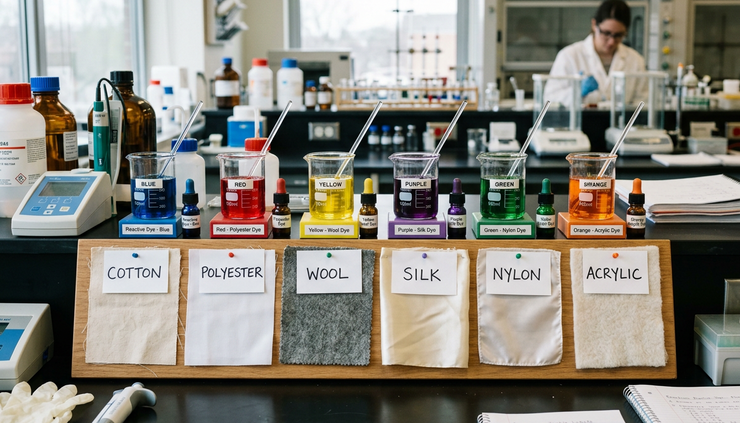
The table below gives a practical fibre-dye map. Actual mill selection may change based on shade, fastness standard, machinery and buyer requirements, but these are the common industrial matches.
Fibre | Most common dye classes | Typical products | Why it works |
Cotton | Reactive, direct, vat, sulphur, azoic, pigment | T-shirts, denim, shirts, towels, bedsheets | Cellulose can bond with reactive dyes and can absorb several cellulose dye classes |
Viscose | Reactive, direct, vat, pigment | Dresses, linings, scarves, home textiles | Viscose is regenerated cellulose, so it behaves close to cotton but swells more |
Linen | Reactive, direct, vat, pigment | Shirts, sarees, furnishings | Linen is cellulose, so cotton dye classes generally work |
Polyester | Disperse, pigment for printing | Sportswear, sarees, suiting, curtains | Polyester is hydrophobic and needs disperse dyes that diffuse into the fibre |
Wool | Acid, reactive for wool, metal-complex, mordant | Shawls, suiting, knitwear, carpets | Wool has protein groups that attract acid dyes |
Silk | Acid, reactive, direct, basic in some cases | Sarees, scarves, luxury fabrics | Silk is protein-based and dyes well with acid dyes under controlled conditions |
Nylon | Acid, metal-complex, disperse in some cases | Hosiery, swimwear, carpets, technical fabrics | Nylon has dye sites similar to protein fibres and accepts acid dyes |
Acrylic | Basic dyes, disperse in some modified types | Sweaters, blankets, furnishings | Acrylic has sites that attract basic dyes |
Acetate | Disperse dyes | Linings, fashion fabrics | Acetate has low water affinity and accepts disperse dyes |
Cotton-polyester blend | Reactive plus disperse, vat plus disperse, pigment printing | Shirts, uniforms, bed linen | Each fibre needs its own dye class unless pigment printing is used |
Wool-nylon blend | Acid dyes, selected metal-complex dyes | Carpets, socks, knitwear | Both fibres can accept acid dyes, but shade matching needs control |
Fibre-wise dye selection in real textile production
A fibre-dye table is useful, but real production involves more than matching chemistry. A dyer also checks shade depth, fastness demand, processing cost and end use.
Cotton dyeing choices
For cotton, reactive dyes are the common choice for bright shades and good wash fastness. Cotton T-shirts, bedsheets and towels often use reactive dyes because consumers wash them many times.
Vat dyes are chosen when very high fastness is needed. Workwear and some uniform fabrics use vat dyes because they resist repeated laundering. Indigo, a vat dye, dominates denim.
Sulphur dyes are chosen for economical dark shades. Sulphur black is common in black denim and casual cotton garments. The trade-off is lower brilliance and possible environmental load if sulphide systems are not controlled.
Pigment colouring is common when the fabric is printed rather than fully dyed. It is also used for garment effects, especially where a washed-down look is desired.
Polyester dyeing choices
Polyester is mostly dyed with disperse dyes. The process usually needs high temperature because polyester has a tight structure. For pale shades, exhaustion and washing demands may be moderate. For deep shades, removal of surface dye becomes more important to improve rubbing and washing fastness.
Polyester-cotton blends need special care. The polyester part may be dyed with disperse dyes, while the cotton part may be dyed with reactive or vat dyes. This two-class dyeing increases process steps and wastewater load.
Pigment printing avoids separate dyeing of both fibre types, so it is common for printed blend fabrics. The limitation is feel and rubbing fastness in heavy prints.
Wool and silk dyeing choices
Wool and silk are protein fibres. Acid dyes are widely used because they give bright colours and good fibre affinity. Dyeing must be controlled because high temperature, strong alkali or harsh mechanical action can damage these fibres.
Metal-complex dyes are used when better wet fastness and light fastness are required, especially in wool. The environmental concern depends on the metal and its control in wastewater. Modern standards restrict harmful metal residues.
Silk can be dyed with acid dyes and selected reactive dyes. For high-value silk sarees and scarves, shade levelness and handle are critical. Over-processing can reduce lustre.
Nylon and acrylic dyeing choices
Nylon accepts acid dyes well, so it is often dyed using acid dyes for hosiery, swimwear and carpets. Nylon can show shade variation if fibre batches differ, because dye uptake depends on available dye sites.
Acrylic is mainly dyed with basic dyes. Basic dyes give strong, bright shades on acrylic blankets, sweaters and furnishing fabrics. Effluent colour can be intense even at low dye concentration, so treatment must remove colour effectively.
Which dyes create more pollution
No dye class pollutes only because of its name. Pollution depends on the dye structure, fixation percentage, salt and chemical use, washing demand, shade depth, equipment, water recycling and effluent treatment. Still, some dye classes are more often linked with higher environmental risk.
Textile effluent is difficult because it may contain colour, dissolved salts, surfactants, alkali, acids, finishing chemicals and suspended solids. The Indian textile clusters in Tiruppur, Surat, Ludhiana, Panipat and Ahmedabad have all faced public pressure at different times due to dyeing and processing wastewater. This is why many mills now use common effluent treatment plants, zero liquid discharge systems in sensitive regions, and restricted substance lists from buyers.
Reactive dyes can create high salt and coloured effluent
Reactive dyes are widely used and technically valuable, but they can create pollution when fixation is not high. Some dye hydrolyses in water and cannot attach to cotton. That unfixed dye must be washed out.
Main pollution points:
High salt use in many cotton reactive dyeing recipes
Alkali use for fixation
Coloured wash water from unfixed dye
High washing demand after dyeing
Reactive dye effluent can be hard to decolourise because many reactive dyes are water-soluble. Effluent treatment must handle both colour and dissolved salts. Low-salt reactive dyes, better process control and improved washing can reduce the burden.
Sulphur dyes are risky when sulphide systems are used poorly
Sulphur dyes, especially sulphur black, are economical and widely used. The concern comes from reducing agents such as sodium sulphide in traditional processes.
Main pollution points:
Sulphide in wastewater
Bad odour from sulphur compounds
High chemical oxygen demand, which indicates oxygen-consuming substances in wastewater
Risk of tendering in stored fabric if acidic residues remain, especially in old or poorly controlled processes
Modern sulphur dyeing can use lower-sulphide or sulphide-free reducing systems. Better oxidation and washing also reduce risk.
Vat dyes need strong reduction and oxidation control
Vat dyes give excellent fastness, but the dyeing method can be chemically demanding. The dye must be reduced to a soluble form, then oxidised back to its insoluble form.
Main pollution points:
Reducing agents in effluent
Strong alkali
Repeated washing
High process control requirement
Indigo denim dyeing is a special case. It uses repeated dip and oxidation cycles. Large denim production can consume significant water if washers and recovery systems are not managed well. Foam dyeing, better dosing and water recycling are being used in parts of the industry to reduce this load.
Disperse dyes can affect aquatic life if not treated well
Disperse dyes are essential for polyester, but they are not very water-soluble. They are applied as fine dispersions with dispersing agents. Some dye particles and auxiliaries can remain in wastewater.
Main pollution points:
Dispersing agents and unfixed dye
Reduction clearing chemicals in deep polyester shades
Carrier chemicals in older low-temperature polyester dyeing
Possible staining of other fibres in blended goods
Some disperse dyes have also been associated with skin sensitisation concerns, which is why buyer restricted lists often control selected disperse dyes. Good sourcing matters.
Azo dyes are a concern when they release banned amines
Azo dyes are a large family. Many important textile dyes are azo dyes, including some reactive, direct, acid and disperse dyes. The issue is not “azo” as a whole. The issue is certain azo dyes that can break down into restricted aromatic amines.
The European Union’s REACH rules restrict azo colourants that may release listed carcinogenic amines in textile and leather articles that contact skin or mouth. Many global brands follow similar restricted substance lists. India also has standards and export requirements linked to restricted azo dyes.
Main pollution and safety points:
Risk from banned aromatic amines
Concern during dye manufacture, processing and disposal
Need for proper chemical purchasing and testing
A mill should not judge safety by colour alone. It should buy dyes with proper compliance documents and, when needed, test finished goods.
Mordant dyes can pollute when heavy metals are used
Mordant dyes may use metal salts to fix colour. Traditional chrome mordanting can create heavy metal concerns if not controlled.
Main pollution points:
Heavy metal residues
Sludge disposal problems
Worker exposure risk
Restrictions from buyers and regulators
This is one reason natural dyeing is not automatically safer. If a natural dye uses a harmful mordant, the final environmental profile may be poor.
Pigments have lower wash-off but binder impact matters
Pigment printing often has lower wastewater load because the print may not need heavy washing after curing. This is a major advantage compared with many dye printing systems.
But pigments are not impact-free.
Main pollution points:
Binder chemistry
Formaldehyde risk from some older binders or fixing systems
Rubbing loss of pigment particles
Handle problems that lead to higher softener use
Modern water-based pigment systems can be cleaner than older systems, but performance depends on binder selection, curing quality and chemical compliance.
Ranking dye classes by pollution risk
This ranking is a practical guide, not an absolute rule. A well-controlled reactive dyehouse may pollute less than a poorly controlled pigment printer. Still, from a textile processing viewpoint, the following classes often need extra attention.
Higher pollution concern | Main reason | Better practice |
Certain banned azo dyes | Can release restricted aromatic amines | Use compliant dyes and test when required |
Sulphur dyes with sodium sulphide | Sulphide, odour and high chemical load | Use low-sulphide systems and proper oxidation |
Vat dyes in poorly controlled systems | Reducing agents, alkali and wash water | Control reduction, oxidation and washing |
Reactive dyes on cotton | Salt, alkali and unfixed hydrolysed dye | Use high-fixation dyes, low-salt methods and better washing |
Disperse dyes on polyester | Dispersants, unfixed particles and clearing chemicals | Use controlled high-temperature dyeing and good effluent treatment |
Chrome mordant systems | Heavy metal residues | Avoid harmful mordants or recover and treat metals properly |
Pigment printing with poor binders | Binder residues and rubbing loss | Use compliant binders and correct curing |
How mills reduce dye pollution
Pollution reduction starts before dyeing. Chemical selection, recipe design and process control matter as much as the effluent plant.
Choose dyes with higher fixation
Higher fixation means more dye stays on the fibre and less goes to wastewater. In reactive dyeing, high-fixation dyes can reduce colour in wash-off liquor. In polyester dyeing, correct dye selection reduces surface staining and clearing demand.
Match dye class to fibre correctly
Wrong dye selection causes poor exhaustion and more washing. For example, using a dye with poor affinity for a fibre wastes colour and increases drain loss. Correct fibre identification is basic but critical, especially in blends.
Control pH, temperature and time
Dyeing is sensitive to process conditions. Wrong pH can damage wool, reduce reactive dye fixation, or cause uneven dyeing. Wrong temperature can reduce polyester dye uptake or cause shade variation.
Reduce salt where possible
Reactive dyeing of cotton often uses significant salt. Low-salt dyes, cationised cotton and better dosing systems can reduce salt load. Cationised cotton means cotton is modified to attract anionic dyes more strongly, so less salt is needed. This process must be assessed for cost and chemical impact.
Improve washing-off
Poor washing leaves unfixed dye on fabric and causes fastness failure. Excessive washing wastes water and energy. Counter-current washing, where cleaner water meets cleaner fabric and dirtier water meets dirtier fabric, can reduce water use.
Treat effluent according to the pollutant
Colour removal may need biological treatment, chemical treatment, activated carbon, membrane filtration or advanced oxidation. No single method suits all dyehouse effluent. High salt wastewater, common in reactive dyeing, is especially difficult for biological treatment.
Follow restricted substance lists
Industry programmes such as ZDHC publish a Manufacturing Restricted Substances List, which limits harmful chemicals used in textile production. Many export buyers also require compliance with restricted substance lists. These systems help prevent harmful dyes and auxiliaries from entering production in the first place.
A practical way to remember dye selection
For quick revision, use the fibre first, then the dye class.
Cellulose fibres Cotton, viscose and linen usually use reactive, direct, vat, sulphur or pigments.
Polyester Polyester usually uses disperse dyes.
Protein fibres Wool and silk usually use acid dyes, selected reactive dyes or metal-complex dyes.
Nylon Nylon usually uses acid dyes.
Acrylic Acrylic usually uses basic dyes.
Blends Blends may need two dye classes, or pigment printing if suitable.
This fibre-first thinking prevents many mistakes in dye selection.
Key takeaway
Dyes and pigments both colour textiles, but they do not work in the same way. Dyes have affinity for fibres and often enter or bond with them. Pigments are insoluble particles that need a binder to stay on fabric.
The main industrial dye classes are reactive, direct, vat, sulphur, disperse, acid, basic, mordant, azoic, solvent and natural dyes. Cotton mainly uses reactive, vat, sulphur and direct dyes. Polyester uses disperse dyes. Wool, silk and nylon use acid dyes. Acrylic uses basic dyes. Pigments can work across many fibres, especially in printing.
The most polluting dye systems are usually linked to poor fixation, harmful dye chemistry, heavy salt use, reducing agents, sulphides, heavy metals or weak effluent treatment. Reactive dyes can create salt-rich coloured wastewater. Sulphur and vat dyes need reducing chemistry. Certain azo dyes are restricted because they can release harmful amines. Chrome mordanting can create heavy metal concerns.
Good dyeing is not only about shade matching. It is about choosing the right colourant for the fibre, fixing as much colour as possible, washing only as much as needed, and keeping harmful chemistry out of the process from the start.

Comments