
International Care Labeling Guide for Garments and Lingerie: Technical Standards, Testing, and Product Longevity
A care label is a small textile trim carrying significant technical, legal, and operational responsibility. When specified correctly, a garment maintains its structural integrity, dimensional stability, appearance, and fit throughout its intended lifecycle. Conversely, incorrect specifications lead to customer dissatisfaction and product failure—manifesting as thermal shrinkage, dye bleeding, cup deformation, elastic fatigue, delamination, print degradation, and seam puckering.
Care labeling should not be treated as promotional copy or an afterthought. It is a performance specification. For apparel and engineered intimate wear (such as bras), a care label translates fiber chemistry, structural composition, wet processing parameters, trim specifications, and physical tolerances into standardized, international symbols.
This guide explains the international care symbol system, how to read it, how to choose the right label instructions, and how bras should be washed and stored if they are expected to last.

1. Care Labels as Technical Specifications
A care label operates at the intersection of product development, quality assurance, and consumer utilization. Lab testing, sample approvals, and pre-shipment inspections do not guarantee product performance if the care instructions misguide the end user.
Key Rule: A care instruction must define the least damaging, commercially practical care process that preserves the garment's functional and aesthetic parameters.
Care instructions must be grounded in empirical testing rather than arbitrary caution:
Accuracy over Restriction: If a viscose garment experiences a length change above 40°C, specifying a 30°C wash or professional dry cleaning reflects technical precision. However, labeling a robust 100% cotton T-shirt as "Hand Wash Only" creates unnecessary friction for consumers and degrades brand value.
Component-Level Evaluation: Complex garments like structured bras feature diverse material interactions—elastics, molded polyurethane foam, underwires, plush hook-and-eye tapes, adjustment hardware, lace, and bonded laminates. Each material exhibits distinct responses to thermal stress, mechanical agitation, pH levels, and drying mechanics.
2. Standardized International Care Symbol Systems
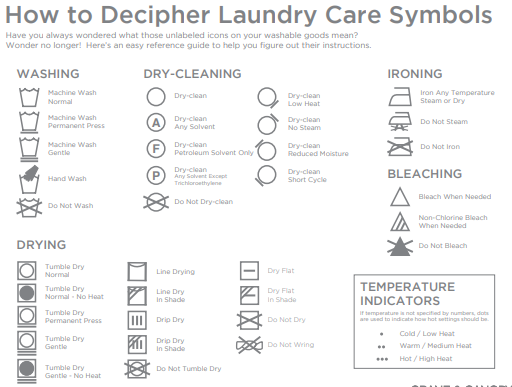
International care labeling utilizes standardized visual language to eliminate regional translation barriers. The primary international benchmark is ISO 3758, managed in many markets by GINETEX. Other key regional standards include ASTM D5489 (United States) and JIS L 0001 (Japan).
International Care Sequence
Care symbols must follow a standardized sequence representing the product care lifecycle:
Washing (Washtub)
Bleaching (Triangle)
Drying (Square)
Ironing (Iron)
Professional Textile Care (Circle)
2.1 Washing Symbols & Water Parameters
Use lower temperatures when the garment has:
Dark or unstable colors
Elastane or heat-sensitive components
Delicate surface texture
Adhesive bonding
Foam- or molded structure
Heavy embellishment
Uncertain shrinkage control
A “hand wash” symbol should mean true hand washing. If a garment can handle a machine-delicicate cycle in a mesh bag, that should be tested and stated accordingly. If it cannot, the label should not leave room for interpretation.
2.2 Bleaching, Drying, and Ironing Symbols
Care Category | Base Symbol | Parameter- Controlled | Key Variations & Modifiers |
Washing | Washtub | Water temperature, mechanical agitation, cycle severity | Hand wash, machine wash temperature (30°C, 40°C), gentle/delicate cycle (single bar), very gentle (double bar), do not wash (X) |
Bleaching | Triangle | Oxidation agents (Chlorine vs. Non-Chlorine/Oxygen) | Any bleach allowed, non-chlorine bleach only, do not bleach (X) |
Drying | Square | Mechanical tumble drying vs. natural drying methods | Tumble dry low/medium/high heat, line dry, flat dry, drip dry, dry in shade, do not tumble dry (X) |
Ironing | Iron | Soleplate temperature, steam applicability | Low (110°C), Medium (150°C), High (200°C), Do not iron (X), Do not steam |
Professional Care | Circle | Solvents and process parameters for dry/wet cleaning | Dry clean (P, F, or A solvent codes), professional wet clean (W), Do not dry clean (X) |
3. Supplementary Text Instructions & Common Labeling Mistakes
While symbols form the baseline, explicit text supplements clear up operational ambiguities. Supplementary copy must always align with primary symbols.
Common Recommended Supplementary Text:
Wash inside out / Wash with similar colors
Use a neutral/mild detergent
Remove promptly after the wash cycle
Line-dry in shade / Do not wring or twist
Do not iron directly on prints, trims, or embellishments
Use a protective mesh wash bag
The same errors appear across product categories. In a technically mature supply chain, they are avoidable.
Copying labels from a similar style
A similar style is not the same style. A change in dye lot, lace supplier, print chemistry, cup foam, elastic width, or bonding adhesive can change care performance. Previous labels are useful references, not proof.
Using the most restrictive label without reason
Over-restrictive labelling can be as poor as under-restrictive labelling. If a cotton-polyester blouse can be safely machine-washed, marking it “dry clean only” creates unnecessary cost and irritation for the consumer.
Ignoring trims during testing
Trims fail in ways fabric tests do not always predict. Metal plating can corrode. Plastic rings can crack. Hooks can snag. Printed labels can fade. Elastic lace can lose recovery. Every component needs a care compatibility review.
Treating “do not tumble dry” as optional text
Tumble drying is a major source of heat and mechanical stress. If testing shows risk, the symbol and text should make this clear. For bras, the default should be no tumble drying unless the product has been specifically designed and verified for it.
Forgetting label permanence
The care label must remain legible for the useful life of the garment. Print durability, edge fraying, ink fastness, comfort, and placement all matter. A perfect instruction that disappears after a few washes is not a working label.
Creating symbol and text contradictions
This is one of the easiest mistakes to catch and one of the hardest to defend. The symbol set, written instruction, carton marking, website care copy, and buyer manual should all agree.
4. Technical Criteria for Selecting Care Instructions
Determining care instructions requires a thorough technical review across five core areas during early-stage development:
A. Fiber Composition & Polymer Characteristics
Cellulosics (Cotton, Linen, Rayon, Viscose, Modal): Susceptible to dimensional change (shrinkage/swelling) and wet strength loss (viscose/modal).
Proteins (Wool, Silk): Highly sensitive to alkaline pH, heat, and mechanical agitation (felting/water spotting).
Synthetics (Polyester, Nylon): Thermoplastic; generally resilient to washing but retain oleophilic stains and warp under excessive heat.
Elastomers (Elastane/Spandex): Highly sensitive to thermal degradation, chlorine exposure, and tensile fatigue.
B. Fabric Structure & Stability
Knits (Single Jersey, Interlock, Rib): Risk of spirality/skewness and longitudinal growth or contraction.
Wovens: Risk of seam puckering due to differential shrinkage between face fabric, interlinings, and sewing threads.
Laminates & Bonded Fabrics: Risk of delamination under high wash temperatures, dry-cleaning solvents, or tumble-dry mechanical action.
Dye Systems: Direct, reactive, disperse, and acid dyes require validation against fastness to washing, water, rubbing (crocking), and perspiration.
Specialty Prints/Finishes: Pigments, plastisol, foils, discharge prints, and water-repellent coatings require lower thermal exposure and gentle agitation.
D. Hardware, Trims, and Construction Accessories
Zippers, sliders, underwires, bonded seams, and decorative trims dictate maximum thresholds. A heat-resistant face fabric cannot compensate for a low-melting-point trim or plastic hardware.
E. End-Use & Fit Tolerances
Tight-fitting or load-bearing garments (e.g., activewear, shapewear, and intimate apparel) have narrow dimensional tolerances. Minor dimensional or elasticity changes directly impact garment performance.
5. Complete Lingerie & Bra Maintenance Guide
How to wash bras by hand
Bras are not small garments. They are load-bearing textile structures. The underband stabilizes the product, straps manage tension, cups provide shape, and elastics control recovery. Washing and storage either preserve that structure or gradually destroy it.
The strongest opinion in this guide is simple: most bras should be hand washed or machine washed only under controlled conditions. Tumble drying, wringing, hot water, chlorine bleach, and careless storage shorten service life.
Hand washing remains the safest method for most bras, especially molded, wired, lace, padded, bonded, or delicate styles.
Use this process:
Fill a clean basin with cool water.
Add a small amount of mild liquid detergent.
Fasten hooks before washing to reduce snagging.
Submerge the bra and move it gently through the water.
Focus on the underband, cradle, and strap areas where body oils collect.
Avoid twisting, scrubbing, or stretching the elastic.
Rinse in cool water until detergent is removed.
Press water out gently using a towel.
Reshape cups by hand.
10. Dry flat or hang from the center gore, away from direct sunlight and heat.
Do not soak bras for long periods. Prolonged soaking can encourage dye bleeding and may affect adhesives, elastics, and metal components.
How to machine wash bras when allowed
Machine washing should be used only if the care label permits it. Even then, the process must be controlled.
Best practice:
Fasten hooks before washing.
Place each bra in a fine mesh laundry bag.
Wash with light garments, not denim, towels, or heavy items.
Use cool water and a gentle cycle.
Use mild detergent.
Avoid bleach and strong alkaline products.
Remove bras promptly after the cycle.
Reshape cups before drying.
A machine wash can be acceptable for some non-wired, non-molded, everyday bras if validated during testing. It is less suitable for wired lace styles, foam-molded cups, longline bras, adhesive-bonded bras, and heavily decorated styles.
What never belongs in bra care
Some processes are consistently harmful.
Hot water
Heat weakens elastane and may distort foam.
Chlorine bleach
It damages elastics and can affect color and components.
Tumble drying
Heat and tumbling deform cups, reduce stretch recovery, and stress wires.
Wringing
Twisting damages the cup shape and elastic structure.
Ironing
Most bras contain heat-sensitive materials.
Drying on radiators or heaters
Direct heat accelerates elastic fatigue and may deform cups.
Optimal Maintenance Workflow
[Preparation] ➔ Fasten hook-and-eye closures to prevent snagging.
│
[ Cleaning ] ➔ Submerge in cool water (<30°C) with a neutral liquid detergent.
│ Gently agitate without twisting, scrubbing, or wringing.
│
[Extraction]➔ Gently press excess moisture out using a clean, dry towel.
│
[Drying] ➔ Reshape cups manually. Air dry flat or hang from the center gore in shade.
6. Proper Storage Guidelines
Good washing can be undone by poor storage. Heat, compression, moisture, and friction continue to affect garments after laundering.
Store garments according to structure.
Knits should usually be folded to avoid hanger growth. Tailored garments may need shaped hangers. Heavy embellished garments should not hang from weak shoulder points. Whites and pale colours should be stored away from direct sunlight and contact with dark or unstable dyes.
Garments must be completely clean and dry before storage. Moisture encourages odour, mildew, metal corrosion, and dye transfer. In humid Indian conditions, this is not a minor issue. Wardrobes need airflow, and seasonal garments should be checked before storing.
For high-value textiles, breathable cotton bags are often better than sealed plastic. Plastic can trap moisture and may cause yellowing or odor over time.
Store bras without crushing the cups.
Moulded bras should be nested in a drawer, cup inside cup, without folding one cup into the other. Folding can create permanent creases in foam. Wired bras should lie in their natural shape, not twisted. Hooks should be fastened to prevent snagging on lace or mesh.
Soft, non-padded bras can be folded more easily, but they still need protection from rough zips, hooks, and Velcro-like surfaces.
Rotation also matters. Bras need rest between wears so the elastic can recover. Wearing the same bra repeatedly without rest accelerates loss of tension in the underband and straps.
Swimwear and sports bras need extra care.
Swimwear and sports bras face sweat, sunscreen, chlorine, salt, and repeated stretch. Rinse them soon after use in cool water. Avoid storing damp items in a gym bag or plastic pouch. Wash gently, dry away from heat, and never rely on tumble drying for speed.
Elastane-rich garments fail faster when exposed to chlorine, heat, and body oils. Careful rinsing and drying are not cosmetic steps. They preserve stretch recovery.


A Practical Care Label Checklist for Garments and Bras
Before final approval, the care label should pass a technical checklist. This is not paperwork. It is risk control.
Checklist Parameter | Garments / Outerwear Target | Intimate Apparel Target |
Material Verification | Shell, lining, interlining, and sewing thread evaluated. | Cups, wings, gore, elastics, wire channels, and trims evaluated. |
Dimensional Stability | Multi-cycle wash testing verified (max shrinkage ≤3-5%). | Multi-cycle wash testing verified (max shrinkage ≤2%). |
Colorfastness | Verified against washing, rubbing, and perspiration. | Verified against perspiration, washing, and migration. |
Heat & Chemical Limits | Iron soleplate and drying parameters established. | Tumble drying and direct heat strictly prohibited. |
Symbol Consistency | ISO / ASTM / JIS symbols match destination market laws. | ISO / ASTM / JIS symbols match destination market laws. |
Text-Symbol Alignment | Zero contradictions between text notes and graphics. | Clear washing and drying instructions present without conflict. |

The right care label protects both product and trust.
A garment care label is a promise about performance. A bra care label is an instruction manual for a small engineered structure. Both require more discipline than copying standard symbols into artwork at the end of production.
The best labels are built from evidence. They consider fiber behavior, construction, colorfastness, trims, heat sensitivity, drying risk, and the way consumers actually wash clothes at home. They are clear enough for everyday users and accurate enough for technical review.
If there is one rule to carry into product development, make it this: choose the care instruction as early as you choose the fabric. A product that cannot survive its intended care route is not finished. It is only waiting to fail in the laundry.
Summary
Developing appropriate care labels requires integrating fiber science, physical testing, and practical user experience. Establishing correct care specifications during early product development protects product quality, reduces returns, and maintains long-term brand credibility.


Treating the care label as a performance specification rather than routine legal copy is an important distinction. In structured lingerie, elastic, mesh, coated hardware and decorative components can respond differently to heat, water and agitation. Care instructions should therefore protect the most sensitive component. This consumer guide offers a useful companion on fit, layering and care: https://lunarness.com/blogs/guides/leather-lingerie-guide-styles-fit-layering-care